I Gave a Fruit Fly's Real Brain a Tinder Account
783 real neurons. 8,454 real synapses. Zero invented wiring.
In April 2025, Janelia FlyEM, Cambridge, and Google published MaleCNS v1.0. It's a full map of an adult male fruit fly brain: every neuron, every synapse, traced from electron microscope images. The license is CC-BY, so anyone can use it. It's built for real neuroscience. I looked at it and thought: I could make this thing judge Tinder profiles.
The Part I Didn't Invent
FlyBrain runs on a piece of that real connectome. 783 neurons, 8,454 synapses, pulled straight from the published dataset by their real IDs. When the app judges a dating photo, the decision runs through LC10a. That's a real neuron. Its actual job in a real fly is tracking moving objects. When it judges a food photo, the decision runs through real taste neurons instead. I didn't design a circuit that seemed right for the job. I took the circuit that already exists and pointed a new kind of input at it.
The only thing I control is a small table of numbers: preference weights. They shift when you swipe, drag a slider, or watch the fly swipe on its own in 3D. Everything past that table runs through the same fixed structure a real fly uses to weigh a gut reaction against something it learned. The mushroom body handles the learned half. The lateral horn handles the gut-reaction half. Both feed into one output, same as in the real insect. Change the weights and you change what the fly likes. You never change how it decides.
Why This Isn't Reinforcement Learning
This part matters, because people hear "AI fly" and assume machine learning. There's no reward signal here. Nothing is being optimized over time. Swiping right doesn't train anything. It sets a number, and a fixed piece of biology reads that number. The hard part was never teaching a fly to learn taste through trial and error. Plenty of systems already do that. The hard part was routing a preference engine through a real, mapped circuit instead of a black box. So when the fly rubs its front legs together over a photo it liked, that gesture sits on top of a decision made by neurons that once belonged to an actual fly.
Watching the Fly on Its Own
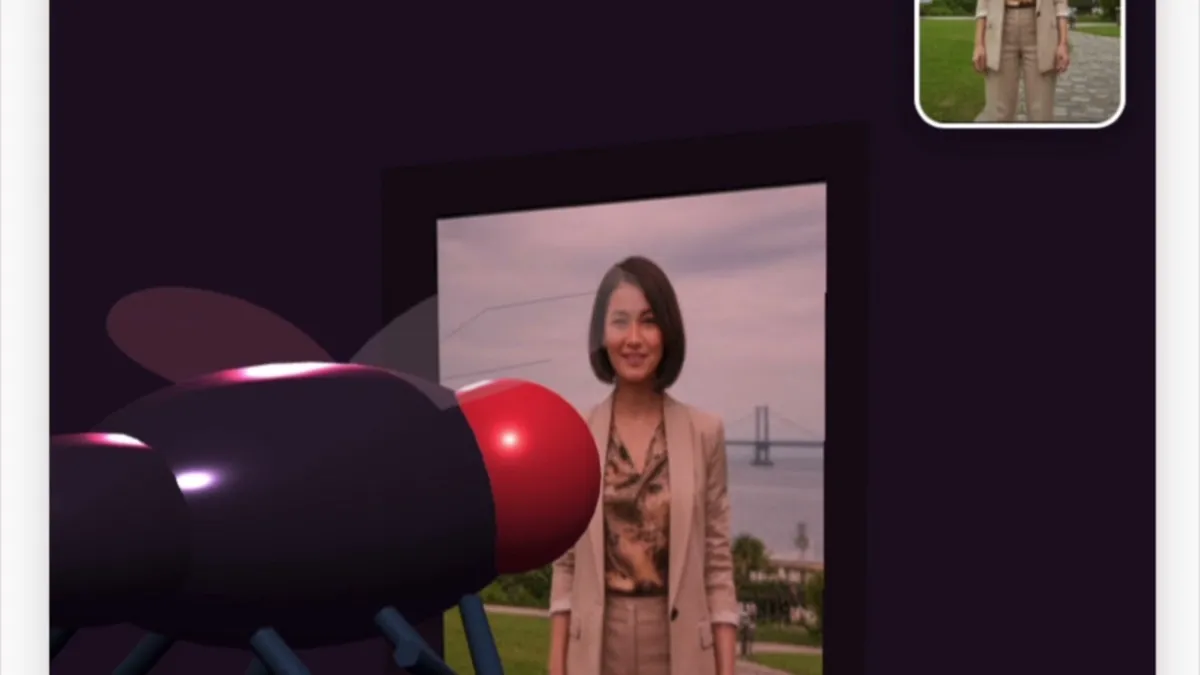
You can swipe the dating and food decks directly, like any card stack. But the mode I keep opening is Watch. A 3D fly sits in frame, camera behind its shoulder, a photo mounted in front of it like a phone screen. It leans in, thinks for a couple seconds, then kicks the photo off screen, or rubs its legs together if it likes what it sees. The gesture isn't decoration bolted onto a result computed somewhere else. It runs off the same verdict as the swipe deck, timed to match.
That scene took longer to get right than the neuroscience did. An early version cropped every photo at the top and bottom. My first guess was the fly's own body blocking the camera. Wrong. The real cause: a clipping plane was calculated before the photo's display group had moved into its final position, so the crop was measured against the wrong starting point. Once I fixed the order of operations, the crop fixed itself.
Building the Photo Set
The photos are AI-generated. Generated photo sets usually fail in two spots: everyone ends up looking like the same region's idea of normal, and everyone ends up conventionally attractive. I tied each setting to a real city that matches the person's background instead of a generic backdrop. I built large enough name pools that nobody shares a name with dozens of other people in the deck. And I varied body type, grooming, and framing enough that the fly's verdicts don't turn into a streak of identical swipes, which is exactly what happened the first time my tag list was too narrow to produce real variety.
What's Real and What Isn't
The neurons are real, from a published dataset anyone can check. The synapse counts are real. The two-pathway structure, gut reaction versus learned preference, is modeled on the fly's actual anatomy. The photos are not real people. The preference table is not a trained model. The fly doesn't actually want anything. It's a real piece of brain data, pointed at a job the original fly never had, with the joke sitting on the surface and the biology holding up underneath it.